Thursday, December 30, 2010

Questions You SHOULD Be Asking Your Lender

More and more, consumers are learning that there is much more to getting a mortgage than just the interest rate and points. A good mortgage planner is more in the advice business than the lowest price business. With tightening guidelines, often the question first is “Will the loan be approved?” But moreover, the borrowers’ concerns need to involve some of the answers to these non-price questions:

1. What type of lender should I use?
There are three basic types of lenders. Mortgage BROKERS promote a broad product menu, competitive pricing, and entrepreneurial approach; however, BROKERS cannot lock, commit, or approve your loan because they are not actual lenders. Banks and Credit Unions rely on financial strength, direct lending capabilities, and stability; however, the have limited product menus and often a “cover my ass” mentality. Mortgage BANKERS blend the best of both- direct lending ability, financial strength and stability, wide product offerings, competitive pricing and the entrepreneurial spirit.


2. What loan products should I be considering?
Make sure your lender has multiple types of products (Conventional, FHA, VA, State Mortgage Agency Products, etc.). While most people today do choose a 30 year fixed, it is not always the wisest choice. Borrowers need to consider how long they will be staying in the home and any changes in their income during that time period before just accepting the same loan as everyone else. Additionally, with many properties in need of some renovations or repairs, you need to explore the FHA 203K Program.

3. Should I lock or float my interest rate?
Most mortgage planners are trained to dodge this question. I believe you should be hiring an expert who should have an informed opinion about the direction of rates….in the short term and the long term. Weighing numerous factors ranging from your projected closing date to upcoming economic reports, a good mortgage planner can counsel a client into saving money. While no one can predict with absolute certainty, you need to reach a comfort level that the lender you choose has the best information and your best interest at heart.

4. What are mortgage rates based on?
There is only one correct answer. It is the pricing of Mortgage Backed Securities. (Unfortunately, too many people answer the 10-year Treasury Bill.) If you get the wrong answer on this basic question, what else don’t they know?

5. How do economic releases impact rates?
How will a Jobs Report, a Fed Board Meeting or Inflation Number affect your home loan? Your mortgage planner should know, should explain it to you, and keep you informed.

6. Can I improve my chances of approval while keeping costs low?
Sometimes even minor improvements in a credit score, the amount of your down payment, or how you position your assets can make a big difference. During your counseling sessions, your mortgage planner should be advising you on how the “little things can make a big difference’”

Good advice, whether it’s from your doctor, lawyer, real estate agent or lender, can be invaluable. Finding a lender who is an expert….who has your goals in mind…and who offers creative solutions is one of the most important factors in a successful real estate transaction.

For a knowledgeable Colorado Springs Lender, contact Mike MacGuire, your Colorado Springs Real Estate Expert. If you have questions about Purchasing a Home for Sale in Colorado Springs or Selling a Home in Colorado Springs, contact Mike today!

Wednesday, December 29, 2010

2011: The Year a House Again Becomes a Home

For almost a decade now, every time we talked about real estate we immediately discussed money. We didn’t talk about the value of a home but instead about the price of the house. We didn’t worry about a roof over our heads but instead the ceiling on our interest rate. We didn’t care as much about where we raised our family as we cared about how much we increased our family’s net worth.

That will change in 2011. We believe very strongly that real estate will return to what it has been for the 200+ year history of this country: a place for us and our families to live comfortably. It will also prove to be a great long term investment as it always has been.

Our parents and our grandparents didn’t buy their homes as a short term financial investment. They bought it so they had a place of their own to come home to at the end of the day; a place to raise their family; a place they could feel safe.

Sure they dreamed of a ‘mortgage-burning’ party. They realized it was a form of forced savings. They were taught that, if they paid their mortgage every month, they would wind up with a little retirement account decades later.

And, they realized that wouldn’t happen if they rented.

However, in the last decade, we somehow forgot that the financial aspect was the serendipity not the major reason to buy. We believe that 2011 will be the year that people return to the historic reasons families purchased a home. This is the year when we again remember that homeownership is a major part of the American Dream.

What about the challenges to a housing recovery? Let’s look at them.

The Economy
Most reports are showing that the economy is doing better than expected. This shopping season provided additional proof of this point. As the economy recovers, so will consumer confidence. This will be great news for housing.

Unemployment
There is much talk about a ‘jobless recovery’. We agree that unemployment will continue to be a challenge. However, when you talk about housing, it is not the unemployment rate that is all telling. Instead, it is the change in the rate. As unemployment skyrocketed, people started to worry about their own job. Any change creates concern. Unabated concern turns to fear. Fear causes paralysis. The spike in unemployment has plateaued. People no longer have the felling that ‘they are next’. The fear will diminish and people will start moving on with their lives. This too will be great news for housing.

Interest Rates
It seems the bottomless pit in which rates have been falling does have a floor after all. And it seems we have found it. Those purchasers who had been waiting for the best interest rate may have already missed it.

Prices
Economists are projecting that prices will not see any appreciation in 2011. Sellers who had been waiting for 2006 to return will come to the realization that waiting any longer makes little sense. They will instead decide to get on with their lives and sell this year.

Prices probably will soften further. However, the possible savings to potential buyers will be minimized by a rise in interest rates.

Bottom Line
This is the year that normalcy returns to real estate. People will buy and sell based on the desire for a better life for themselves and their families. They will realize that is the true value of homeownership and they will be willing to pay for that value.

For More Information on the Colorado Springs Real Estate Market, Contact Mike MacGuire, your Colorado Springs Real Estate Expert.

Tuesday, December 28, 2010

Real Estate 2010: The Year of Intervention

This past year has been very challenging for real estate. The market was defined by outside intervention. This intervention tugged at historic trends. Government involvment caused market fundamentals to be distorted beyond recognition. Unpredictability was the only thing we could predict.

Modifications


The administration’s announced goal of the modification program was to save 3-4 million families from losing their homes. The actual number of homeowners assisted will come in at less than one million. Most consider the program a failure.

However, we believe that there was a secondary unannounced goal of the modification program: to slow the flow of foreclosed homes to the market. Putting homes through the modification process prevented banks from moving forward with the repossession process as quickly as they normally would.

Limiting supply was one of the ways the administration used to help stabilize home prices. However, the administration has recently slowed the modification process (see graph below from the latest Economic Letter from the Dallas Fed). Going into 2011, a larger number of foreclosed properties will enter the market.


Interest Rates
The administration began to control rates back in 2009 with the purchase of mortgage-backed-securities. When it was announced that the government would back off the purchases in the spring of 2010, everyone (including us) believed that mortgage rates would climb back to historic norms (6-7%) by the end of the year. The exact opposite took place. Rates fell to almost 4% on 30-year mortgages before jumping back to the 4.5 – 5% range at the end of the year.

The most amazing part was that the lower interest rates did not seem to spur buyer activity as sales softened while rates continued to fall through the year. Interest rates, at best, helped in maintaining demand in 2010.

Home Buyers’ Tax Credit
Again, the administration’s goal was to stabilize home values. The tax credit was supposed to drive housing demand. And it did – for the first four months of the year. However, it now appears that the tax credit did not increase demand, but instead, just pulled that demand forward. (see graph below which is also from the Dallas Fed).


Bottom Line
By decreasing supply (mortgage modifications limited the number and impacted the speed of foreclosures entering the market) and increasing demand (lowering interest rates and issuing a tax credit), the administration tried to stabilize the housing market. They accomplished some of their goals in a limited way.

We will not see this magnitude of government intervention in 2011 however. What will that mean to housing next year? I will give my thoughts on that in tomorrow’s blog.


For More Information on the Colorado Springs Housing Market, contact Mike MacGuire, your Colorado Springs Real Estate Expert, for more information on Homes for Sale in Colorado Springs and Purchasing a Home For Sale in Colorado Springs!

Monday, December 27, 2010

Dr. Doom, Mr. Bear and Real Estate

Trying to negotiate the current housing market is difficult. There are so many external variables impacting real estate it seems almost impossible to project where sales and prices are headed. But, there were two people who saw the challenges we are currently experiencing back in 2005-2006. They looked at the market and predicted we were in for the collapse that occurred. Who are these men? How do they see real estate today? What are they doing to take advantage of the current market?

Dr. Doom
Nouriel Roubini is a teacher at New York University. He warned that borrowers defaulting on their mortgage loans would unleash a housing bust and deep recession.

According to the Wall Street Journal Roubini is:

…the New York economist whose warnings of a housing collapse earned him the nickname “Dr. Doom” … Ever since much of his dire forecasting came true, Mr. Roubini has become one of the world’s most recognizable economists. He has been in demand as a speaker and consultant, often shuttling around the globe to advise central bankers and finance ministers.

Mr. Bear
John Paulson is the person who made a fortune betting that the subprime mortgage mess would cause the real estate market to collapse. He understands how the housing market works and knows when to buy and when to sell. What do others think of Paulson?

According to Forbes John Paulson is:

…a multibillionaire hedge fund operator and the investment genius who made a killing going short subprime mortgages a few years ago.

Why discuss these gentlemen today?
The interesting thing is that both these gurus just purchased real estate in New York. The Wall Street Journal reports Roubini:

just plunked down $5.5 million for an East Village penthouse loft, public records show …
Real-estate people in New York were quick to seize on his purchase as a healthy sign for the local property market.

“Even the most bearish think our market has nowhere to go but up,” said Frederick Peters, president of Warburg Realty Partners.

“Dr. Doom is a little late to catch the bottom, but there’s still plenty of upside at this point.”


Paulson also just closed on a multi-million dollar home:

Mr. Paulson purchased a two-bedroom apartment at Olympic Tower, a luxury condominium on Fifth Avenue across the street from St. Patrick’s Cathedral and Rockefeller Center, for $2.85 million, according to public records. The 51-story building was developed by Aristotle Onassis and is popular with part-time residents from abroad.

Bottom Line
It seems that Mr. Bear and Dr. Doom are looking at the real estate market quite differently right now. Does that mean the market is at its bottom and about to turn for the better? Mr. Paulson recently put it this way:

“If you don’t own a home, buy one. If you own one home, buy another one. And if you own two homes, buy a third and lend your relatives the money to buy one.”

Looking for answers to your Colorado Springs Real Estate questions? Contact Mike MacGuire, your Colorado Springs Real Estate Expert, if you have questions about Homes for Sale in Colorado Springs or Selling in Colorado Springs.

Wednesday, December 22, 2010

Prices Compared to Historic Trend Lines

Last week, I did a blog post on house prices as compared to income levels. I showed that, using historic ratios, house values were lower than previous norms. Many people asked us if we believe that home prices were about to increase. As I said in the post:

Some experts are predicting that today’s values will drop and not be seen again until the middle of 2012 at the earliest. We concur with these estimates…

It is understood that prices are determined by supply and demand. Inventories are still very high and a lack of consumer confidence is limiting demand. Prices will continue to soften through the first half of 2011 (most experts are calling for a 5-8% decline) before appreciating again.

However, the current market has been dramatically impacted by a foreclosure crisis never before experienced. What will happen when this cloud of distressed properties starts to dissipate? Where will prices be as compared to previous markets? Have we already surrendered the ‘bubble’ increases we experienced in the middle of the decade?

Research firm Macro Markets sheds some light on this issue in their Gap Gauge . The website describes the gauge as:

… the difference between the current level of a home price index and its baseline trend level. The baseline trend is derived by extrapolating the average rate of index growth before 2000, the year when prices in many real estate markets began appreciating at unprecedented and unsustainable levels. Gap measures the percentage difference between a current index level and its corresponding baseline level.

Basically, it compares the current Case-Shiller Price Index with a trend line of where prices would be based on pre-bubble appreciation. Below is their chart:


As we can see, current national prices are 6.84% LOWER than where the historic trend line says they should be.

Bottom Line
Prices are still declining because of dynamics unique to this particular housing market. Once we return to the factors which normally determine property values, prices should appreciate nicely.

For More Information on the Colorado Springs Housing Market, Contact Mike MacGuire, your Colorado Springs Real Estate Expert.

Tuesday, December 21, 2010

Home For Sale in Colorado Springs

Nice Ranch Style Home for Sale in Colorado Springs is Perfect for the First Time Home Buyer or if you are Relocating to Colorado Springs! Featuring 3 Bedrooms, 2 Bathrooms, 2 Car Detached Garage and 2,576 Square Feet. Tour this Home Today! Located on a Private, Treed 1.05 Acre Lot this Home Boasts a Large Living Room that is Open to the Formal Dining Room. The Ample Sized Kitchen has plenty of cabinets for storage. Main Level Master Bedroom, Finished Basement with 3rd Bedroom, Recreation Area and Storage. Enjoy Peaceful Evenings from the Comfort of your Spacious Deck. Great Location with Easy Access to Fort Carson, I-25, Shopping, Parks and More! If you are interested in this Home for Sale in Colorado Springs, contact Mike MacGuire Today, your Colorado Springs Real Estate Expert!

5 Reasons You Should Sell Today (Updated)

Selling your house in today’s market can be extremely difficult. It is for that reason that every seller should take advantage of each and every chance that appears. There is a fantastic opportunity available right now. Meet with Mike MacGuire, your Colorado Springs Real Estate agent and mortgage professional today and see whether it is the right time for you and your family to make a move.

Here are five reasons you should consider selling in the first 90 days of 2011.

1. Interest rates have spiked up.

Rates have jumped over 1/2 point in the last several weeks. The short term result of increasing rates is a surge of buyers jumping off the fence to purchase in fear that rates may continue climbing upward. This is a short window of opportunity. If rates fall again, buyers will jump back on the fence. If rates continue to rise, it limits the number of buyers who can qualify at each price point. Now is the best time to sell your house.

2. If you are moving up, you can save thousands.

If your family goal is to sell your current house and take advantage of the fabulous selection of properties currently available to buy the home of your dreams a at bargain basement price, DO IT NOW! Prices will continue to soften in most markets. However, if you are buying, COST should be more important than PRICE. Cost can be dramatically impacted by rising mortgage interest rates. Do the math and decide if now is the time.

3. During the winter months, the buyers are serious.

We all realize that buyers are not quick to pull the trigger on the purchase of a home today. There is no sense of urgency with the supply of eligible properties at all time highs. However, at this time of year, the ‘lookers’ are either staying warm (in the North) or just busy with other priorities. The home buyers left in the market are serious and are more apt to buy. Less showings – but to more motivated purchasers.

4. You beat the rush of inventory that is coming next year.

Every year there is an increase of inventory which comes to market from January through April as homeowners put their houses up for sale in preparation for the spring market. Here is the number of listings available for sale in 2010.

January – 3,277,000
February – 3,531,000
March – 3,626,000
April – 4,029,000

We believe there is a pent-up selling demand (homeowners who have held off selling over the last year) that will lead to an increase in these numbers this spring. You won’t have to worry about this increasing competition if you sell now.

5. You have less ‘discounted’ inventory with which to compete.

This year, sellers of non-distressed properties have been given an early holiday present. With banks trying to rectify their foreclosure procedures, there has been a large supply of discounted properties removed from competition. No one knows how long it will take banks to return to the normal flow of foreclosed properties to the market. However, until they do, every homeowner has a better chance of selling their property.

Bottom Line

If you are looking to sell in 2011, there may not be a more opportune time than this right now. Serious buyers, great move-up deals and less competition from super-motivated sellers and foreclosures creates the perfect selling situation. Don’t miss it!

Contact Mike MacGuire Today! Your Colorado Springs Real Estate Expert for More Information on Selling a Home in Colorado Springs or Buying a Home in Colorado Springs.

Monday, December 20, 2010

How Will the Foreclosure Mess Impact Prices?

Three months ago, it was revealed that many banks were guilty of improperly processing the paperwork on their foreclosures. Most banks at the time declared a foreclosure moratorium while they reviewed their paperwork and corrected any errors. Today, we want to give you an update on the situation and explain how the housing market will be affected.

The banks have admitted to some procedural errors. The severity and intent of these errors is still being investigated and the proper sanctions are being debated (one state attorney general is threatening jail time). However, there seems to be no evidence that families were incorrectly forced from their homes.

So what does mean to the housing market?
When this discounted inventory enters the market, it will put downward pressure on house values. Foreclosures entering the market put downward pressure on the non-distressed properties trying to sell. A foreclosure is competition to other homes as they sell for a 41% discount.

When will this inventory come to market?
Celia Chen of Moody’s Analytics on when this inventory is expected to hit the market:

The “robo-signing” scandal is beginning to show up in U.S. foreclosure data. The inventory of homes in foreclosure rose sharply in the fall, reflecting the fact that a number of large mortgage servicers placed a moratorium on foreclosures midway through October, and were thus unable to complete these foreclosures and reduce inventories. Servicers have already lifted some of these moratoriums and it is likely business will return to usual by the beginning of 2011.

…sales of REOs to third parties and other types of distress sales such as short sale or auction sale to a third party will step up in the first quarter of next year as servicers resolve the foreclosure processing issues.


What impact will it have on house prices?
Prices will be affected. The question is to what degree. Ms. Chen explains it simply:

…the larger the ratio of distress sales to normal, nondistress sales, the greater the downward pressure on prices.

How many distressed sales are out there? According to Daren Blomquist, managing editor of the RealtyTrac:

“Even with this big drop in November we do have a continuing building inventory of properties in foreclosure or REO. We’re estimating those properties plus delinquencies to equal 3 million to 4 million homes waiting to hit the market.”

Bottom Line
With the enormity of the challenge, prices can be impacted in a big way. Ms. Chen in her report said she sees a 5% decline in prices through the first three quarters of 2011.

For More Information on the Colorado Springs Housing Market, Contact Mike MacGuire, your Colorado Springs Real Estate Expert to get a detailed Report on the Homes for Sale in Colorado Springs.

Wednesday, December 15, 2010

Negative Equity: Not Good But Improving

Back in October, we posted that falling home prices would drive more homeowners into a negative equity situation where their home was worth less than the amount of their mortgage (also known as the house being ‘under water’ or ‘upside down’). If a homeowner falls further into negative equity, it increases the chances that they will walk away from their mortgage obligation. This is known in the industry as a strategic default. This could dramatically increase the number of foreclosures coming to market and cause house values to fall further.

The Wall Street Journal reported on the impact of negative equity on strategic default:

Most defaults are typically driven by a combination of income shock and negative equity, or what’s known as the “double-trigger” hypothesis. While borrowers who lose their jobs but have equity in their homes can sell and avoid default, those without any equity are left with fewer options.

The most recent Fannie Mae National Housing Survey looked at how people viewed walking away from their mortgage obligation. Here are some of their findings:

Underwater delinquent borrowers are the most likely to have considered stopping their mortgage payments.
Delinquent borrowers are almost three times as likely to have considered stopping their mortgage payments if they know someone who has defaulted on their mortgage.
17% of all people who are delinquent believe the amount they owe on their mortgage is 5-20% more than the value of their home. That number jumps to 29% when they believe the amount they owe on their mortgage is at least 20% more than the value of their home.

The CoreLogic 3rd Quarter Negative Equity Report released Monday showed

… equity data indicating a third consecutive quarterly decline in negative equity for residential properties. CoreLogic reports that 10.8 million, or 22.5 percent, of all residential properties with mortgages were in negative equity at the end of the third quarter of 2010, down from 11.0 million and 23 percent in the second quarter. This is due primarily to foreclosures of severely negative equity properties rather than an increase in home values.

Obviously, the fact that the number is declining is good news for the housing market. However, with prices again falling there is concern that the current situation could worsen. Mark Fleming, chief economist with CoreLogic said:

“Negative equity is a primary factor holding back the housing market and broader economy. The good news is that negative equity is slowly declining, but the bad news is that price declines are accelerating, which may put a stop to or reverse the recent improvement in negative equity.”

Radar Logic addressed the CoreLogic report yesterday in an opinion piece:

According to research by CoreLogic, borrowers become more likely to default the further underwater they become in their mortgages. Thus, falling home prices could increase defaults, foreclosures and, as a result, the inventory of bank-owned properties. Based on our analysis, homes sold by financial firms sold for 38 percent less, on average, than homes sold by other sellers as of September 30, 2010. As such, foreclosed homes represent a low-priced alternative to homes for sale by owner/occupants, and as sales of foreclosed homes become a larger percentage of total sales, owner/occupants face increasing pressure to reduce their asking prices in order to compete. So falling prices could create a self-perpetuating cycle of negative equity, foreclosures, and further price declines.

Bottom Line
If people fall into negative equity, the chances they will strategically default increases. This would lead to more foreclosures which will mean more downward pressure on home values. More homeowners will see themselves in negative equity as prices fall. And round and round we would go. Let’s hope prices hold thus preventing this from happening.

For More Information on the Colorado Springs Housing Market, Contact Mike MacGuire, your Colorado Springs Real Estate Expert for More Information!

Monday, December 13, 2010

Demand for Housing Will Increase in 2011

The last Pending Home Sales Index from the National Association of Realtors (NAR) showed a substantial 10.4% month-over-month increase. According to NAR the index measures:

Housing contract activity. It is based on signed real estate contracts for existing single-family homes, condos and co-ops. A signed contract is not counted as a sale until the transaction closes. Modeling for the PHSI looks at the monthly relationship between existing-home sale contracts and transaction closings over the last four years.

This increase confirms a growing feeling that demand for housing has begun to increase.

Both NAR and Fannie Mae expect an increase in sales over the upcoming five quarters. Here are their projections:


Bottom Line
Sales will increase over the next several quarters. The increase will initiate a housing recovery. However, price increases will not take place until current inventory levels diminish. That could take 12-18 months.

For More Information on the Colorado Springs Housing Market, Contact Mike MacGuire, your Colorado Springs Real Estate Expert.

Friday, December 10, 2010

Insider Secrets to An Optimal Credit Score

As you prepare to apply for credit (like a home mortgage) understand that it is significantly better to have your best possible credit profile BEFORE applying. Working to improve your score during the mortgage process can be done, but there are two problems. One, time to clear up items can become an obstacle when compared the time you are anticipating a closing. And two, lower scores upfront can give an underwriter an additional reason to be uncomfortable with a file. “Sooner, rather than later” should be the mantra of credit score improvements. Here are some tested ways to do it:

Credit Cards – Revolving Debt proportions

Look on the credit report for revolving debt (not installment loans, or “open” accounts)
As a general rule of thumb, the balance should be no more than 30% of the credit limit. So, if it’s more than that, have you should make every attempt to pay it down.

If there are many revolving accounts with high balances, you will most probably need to pay down most or all of them for the best score.
If there is nothing derogatory on the credit report, just high balances on revolving debt, you can often improve the score significantly. But, if there are many derogatory items on the credit report, paying down revolving debt may not help the score very much.
Many lender have software programs that can quickly determining for you which (if any) revolving accounts need to be paid down, and to what balance.

Collections/Judgments:

Paying off or satisfying such a derogatory account does not normally improve the score because the derogatory account still exists, and so still hurts the score. In fact, paying off an old collection may even make the score drop.
However, for collections, the borrower can ask for the account to be completely removed or deleted. If you have not yet paid the collection, you can use that as a bargaining chip.
If there are many collection accounts, removing just 1 or 2 may not do much good. You always need to look at the overall credit picture.
Charge-off accounts behave a little differently than collections. You can sometimes gain points by paying those off.
Your lender likely has a What-if Simulator to experimentally see what affect removing an account has on the score.

Late Dates

When you look at the overall credit report and you see LOTS of late dates, especially ones from within the last year, there is not much you can do to help the score…those lates simply need to drift into the past.
However, if you just see 1 recent late date on 1 account, and just 1 other recent late date on another account, you should call those creditors and ask…beg…for those single late dates to be removed as a courtesy. It may also be that the late dates were a mistake, but don’t push the creditor to admit to making an error. Just ask them to remove it as a courtesy since you have an otherwise perfect payment history with that creditor.
Your lender can use the What-if-Simulator to experimentally see what affect removing a late date has on the score.

Authorized User Accounts-removing or adding

Piggybacking on someone else’s account can help or hurt your score.
If that account has recent late dates, you can most probably improve the score by having the actual account holder remove you as a user.
If the account is a revolving credit card and it’s “maxed out,” you might also improve the score by removing it, but only if you will still have other revolving credit cards on your report.
What about adding someone as an authorized user to a credit card? This may help, but the better course of action is to get the actual card holder to make it a joint account with you. This guarantees that the account will show up on the credit report within a month or two. But be careful…the account should have a lot of history, no late dates, high credit limit, and low balance.

Other things to help

Keep old revolving credit cards open…don’t close them.
Regularly check your credit report to catch errors early. You get a free one each year from each bureau. Go to www.annualcreditreport.com. Don’t do all 3 bureaus at the same time…space it out throughout the year.
Learn more about credit from websites like www.myfico.com and to get addresses to write the bureaus.

While I trust that some of your questions were answered in this blog, I bet many questions were also raised about your individual circumstance. Credit Score Optimization is one of the central reasons why you should engage the expertise of a good loan officer right NOW.

For More Information on a Home Loan, Contact Mike MacGuire, your Colorado Springs Real Estate Expert for More Information!

Thursday, December 9, 2010

Forbes: Housing Had a Superb Decade

Has real estate been a good investment over the last decade? Many people would be quick to answer ‘no’ to that question. However, they would be wrong. Real estate prices in this past decade have appreciated nicely despite the challenges over the last four years.

Forbes.com reported on this issue two days ago:

With all the teeth-gnashing over the real estate bubble, the bust and the mortgage mess, you can be forgiven for failing to notice this little tidbit: Housing had a superb decade.

According to Radar Logic, the value of a square foot of housing in the U.S. is up 58% from its January 2000 level. That represents an average annual gain of 4.3% in the value of one square foot of housing. According to the Case Shiller Pricing Index, home values are still up 34.9% over 2000 prices.

How did real estate compare to the stock market? Forbes answered this question:

The growth in average U.S. housing values looks pretty impressive compared with that of other assets, especially stocks. The S&P 500 is lower now than it was in January 2000. So is the Nasdaq. Even factoring in inflation, which ran between 2.5% and 3.5% for most of the decade, a home purchase really did produce wealth for anybody who opted to sell some stocks and buy at around the time the dot-com crash got rolling.

Bottom Line
Even in what many consider a sub-par decade for the housing industry, real estate proved to be an excellent investment. For More information on the Colorado Springs Housing Market, contact Mike MacGuire, your Colorado Springs Real Estate Expert for more information on the Housing Market in Colorado Springs!

Tuesday, December 7, 2010

House Price Declines Hitting Most States

This winter will see a softening of prices in most parts of the country. If you are considering selling your home in the near future, you should set an appointment with a real estate professional that has experience in the Colorado Springs Real Estate Market. That being said, we want to explain the magnitude of the challenge.

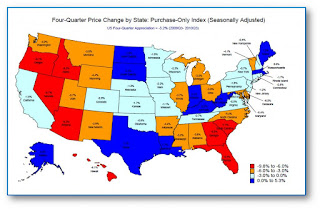
The FHFA just released their third quarter House Price Index. In the titled they claimed: U.S. House Prices Fall 1.6 Percent in the Third Quarter; Declines in Most Parts of the Country

What is the FHFA HPI?
Federal Housing Finance Agency (FHFA) explains their pricing index this way:

The HPI is a broad measure of the movement of single-family house prices. It serves as a timely, accurate indicator of house price trends at various geographic levels. It also provides housing economists with an analytical tool that is useful for estimating changes in the rates of mortgage defaults, prepayments and housing affordability in specific geographic areas. The HPI is a measure designed to capture changes in the value of single-family houses in the U.S. as a whole, in various regions and in smaller areas. The HPI is published by the Federal Housing Finance Agency (FHFA) using data provided by Fannie Mae and Freddie Mac.

How widespread are price declines in the report?
The easiest way to explain this is to show the pricing map contained in the report:


Bottom Line
The majority of states have experienced weakening in house values. Many experts predict this will continue throughout the next several quarters. If you are considering selling in the near future, speak with your local Colorado Springs Real Estate Expert, Mike MacGuire soon to determine where prices are headed in the Colorado Springs Housing Market.

Monday, December 6, 2010

This is Good News for Housing, Not Bad News

We found it interesting to see how some media outlets reported on the latest Fannie Mae National Housing Survey. It is true that the number of people who believe that now is a good time to buy a home dipped 2% since the June report. However, the report also showed that 68% of people still believe it is a good time to buy. That is more than two out of every three people surveyed.

Yet, the headlines seemed to concentrate exclusively on the negative:

Survey: Americans Growing More Cautious on Housing – Wall Street Journal 11/24

Housing Drop: More Bad News for the Economy – Time 11/24

Is the fact that 68% of the people think now is the time to buy bad news? Shouldn’t it be great news? We elect the president of this country with barely 50% of the voters agreeing. A senate ‘supermajority’ only demands 60% to bring out a vote of cloture or to end a filibuster. Over two thirds believing now is the time to buy is fabulous news.

There were two other very revealing findings in the report:

1. People trust homeownership as an investment over buying stocks (66% to 16%). They also trust owning a home over investing in a 401k, buying an insurance annuity or investing in a mutual fund. People find investing in a home safer than any other investment except putting their money into a savings account.

2. 96% of homeowners feel that homeownership has been a positive experience.

Other findings in the report that were not well reported:

62% of renters have long-term ownership aspirations.

Americans continue to expect home rental prices to rise more than home prices over the next year. Americans believe that it is more likely that home rental prices will go up rather than go down by a ratio of almost 4 to 1.

An overwhelming majority of mortgage borrowers remain satisfied with their loans and 3 in 4 Americans are confident they would receive the necessary information to choose the right loan.

Non-financial considerations, such as accessing good education and safety, continue to trump financial reasons for owning a home. With the top three reasons (education, safety, more space) all increasing in percentages since the last report.

Since the time of purchase, 59% of mortgage borrowers have seen their home value increase.

Bottom Line:
The Fannie Mae survey showed that homeownership is still considered by the vast majority as a good investment (66%) and a positive experience (96%). And, 68% think it is a good time for people to buy!!